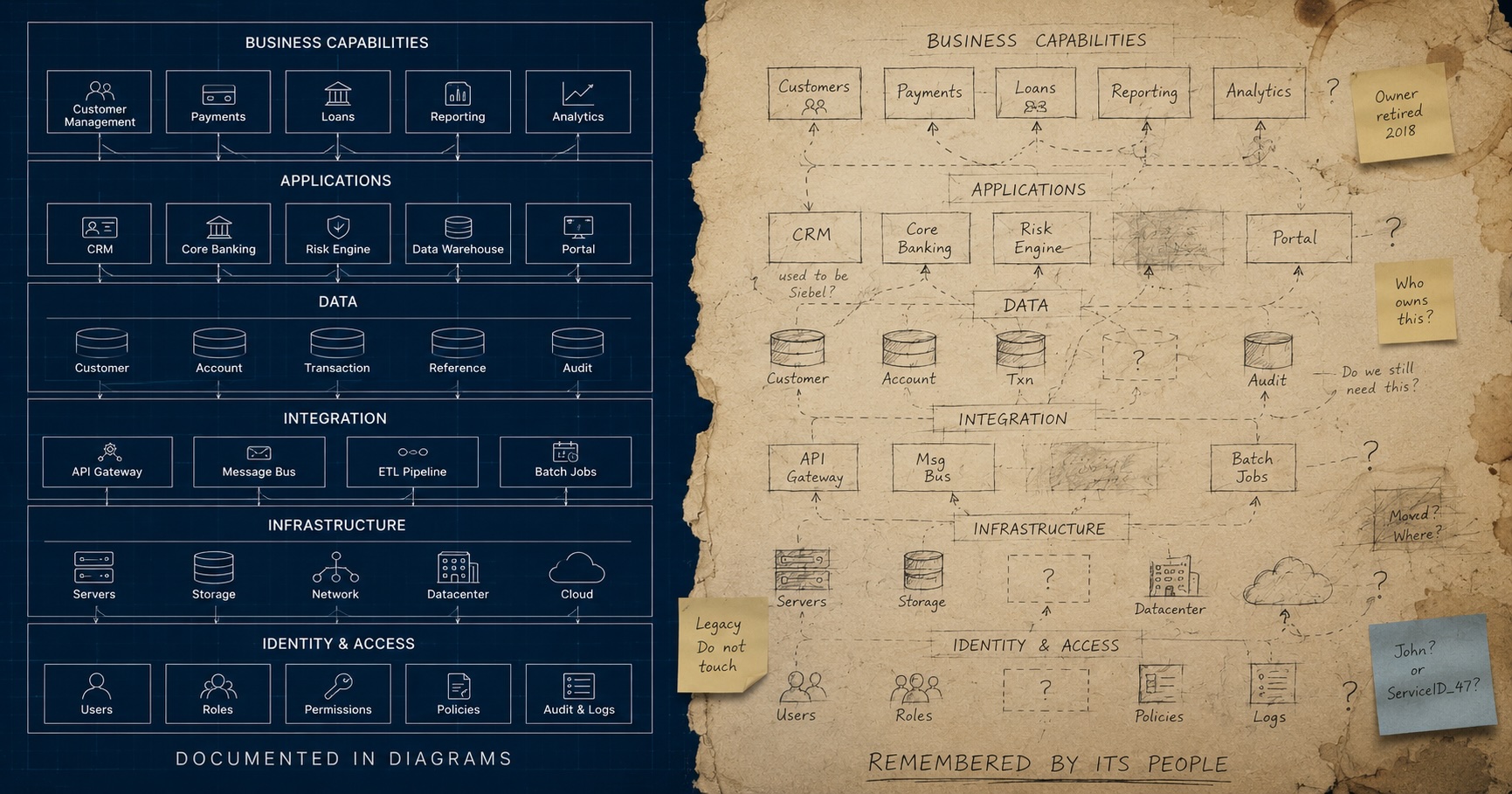
Key takeaway: AI governance depends less on model choice than on whether an organization can explain its own ownership, permissions, and decisions. As AI agents act across systems, identity governance must move beyond certifying what people can access to governing what authority is delegated, to whom, and under what conditions. The organizations best prepared for AI will preserve the institutional memory needed to explain and defend automated action.
Why the future of AI depends less on models than on how well an organization understands itself.
I wouldn't have described it that way then, but one of the most important AI systems I ever worked on was built years before anyone was talking about AI.
It wasn't a machine learning platform or an autonomous agent. It was an internally built enterprise system responsible for reviewing access across more than half a million users and millions of resources spread across mainframes, Unix systems, enterprise applications, and role-based access models accumulated over decades of growth and acquisitions.
For years I saw that platform as an operational necessity. It helped the organization certify access, satisfy regulators, and demonstrate appropriate controls. Looking back, that description misses what we were actually building.
We were building an institutional memory for the enterprise. At the time, I didn’t have that language for it. Only years later, watching organizations struggle to put AI to work, did I realize that was exactly what we had been preserving.
Every enterprise has two kinds of infrastructure. One is visible: servers, networks, cloud platforms, applications, and databases. The other is largely invisible: ownership, identity, permissions, business relationships, and the accumulated knowledge of why a system exists, who depends on it, and what might break if it disappears.
We rarely think of that second layer as infrastructure because it isn't something we can rack in a data center or provision in the cloud. Yet every significant business decision depends on it. AI simply makes that dependency impossible to ignore.
That realization has stayed with me as organizations race to deploy generative AI and agentic systems. Most of today's conversation focuses on picking models, adding guardrails, or complying with emerging AI regulations. Those matter, but they sit downstream of a more basic question.
Does your organization actually know itself well enough for AI to act on its behalf?
The report was never the hard part
Entitlement reviews have long been treated as an administrative chore. Once a quarter or once a year, managers get a list of users and permissions and are asked to certify that everything still looks right. In financial services, these reviews carried extra weight: they were how we enforced segregation of duties, the principle that no single person should be able to initiate, approve, and execute a sensitive transaction alone. Regulators cared, and for good reason. But anyone who has run these programs at scale knows the certification was never the hard part.
The hard part was explaining what the entitlement was actually for. Sometimes the original owner had retired years earlier. Sometimes the application had been renamed twice. Sometimes the business process no longer existed, but the permission remained because nobody wanted to risk breaking production.
Our review process worked fine on paper. The recurring problem was that the manager or resource owner asked to approve an entitlement often had no idea what it did. Half the time the access predated their tenure entirely. They were being asked to vouch for a decision someone else made, for reasons nobody currently at the company could fully reconstruct. So they approved it, because the alternative was chasing down a system that might quietly break something.
That instinct was usually right, because experienced people understood the risk of touching systems they didn't fully understand. AI inherits the permissions, but not that caution.
The system account nobody remembered
We once ran a major cleanup effort targeting system accounts that no one appeared to own or use. It took many months of analysis to build confidence in the list. Once we started decommissioning accounts, applications started breaking. The most memorable case was a mainframe application that simply would not start. It turned out a developer, more than 25 years earlier, had written logic that depended on that specific account existing. Nobody currently supporting the system knew that. We stopped the project immediately.
That experience permanently changed how I think about "unused" resources. In large enterprises, absence of evidence is rarely evidence of absence. More often, it's evidence that institutional memory has already faded. The only reason we learned the truth about that account was because we broke it.
Alongside that, we found the opposite problem just as often: zombie resources still assigned to user IDs of people who had left the company years earlier. Nobody remembered granting the access, nobody remembered removing the person, and the entitlement just persisted, technically valid, practically meaningless.
Both problems come from the same root cause. Organizations are constantly changing. People move roles, teams merge, applications evolve, and institutional knowledge quietly disappears. Humans compensate for this surprisingly well. We ask a colleague who has been around longer. We know that the system labeled "legacy" actually runs a customer-facing service. We know which document is stale and which runbook nobody trusts anymore.
AI has none of that instinct. It assumes the organization already understands itself. That assumption is very often wrong, and unlike a cautious manager, AI won't quietly hesitate before acting on it.
What actually changes with AI
One of the biggest misconceptions I run into is that AI fundamentally rewrites the rules of access governance. It doesn't, not at the level of principle. Least privilege still matters. Ownership still matters. Accountability still matters. What changes is the scale of consequence behind every permission we grant.
Twenty years ago, read access meant a person could view information. That person still had to search, interpret, and decide what to do with it. Human effort was a natural limiter, and so was human visibility: aggregating sensitive insight from scattered, individually harmless pieces of data took real time and usually left a trail. Today, that same permission can let an AI agent pull thousands of documents, correlate data across business units in seconds, and infer conclusions no single document was ever meant to reveal. What used to require deliberate effort, and often a conscious decision to cross a line, now happens as a byproduct of normal operation.
The permission hasn't changed. What it can trigger has.
AI doesn't create the problem, it scales it
Earlier, I argued that AI Data Debt emerges when organizations connect modern AI to decades of unmanaged enterprise information. Identity follows the same pattern. AI doesn't create uncertainty around ownership or permissions. It exposes ambiguity that has quietly accumulated over years of organizational change.
Applications with no identifiable owner. Service accounts nobody wants to touch because nobody knows what depends on them. Entitlements inherited through years of reorganization. Documentation that described the system accurately five years ago and describes almost nothing today. When only humans consumed this information, these gaps were an annoyance, and experienced people quietly worked around them every day. AI doesn't work around them. It scales them, instantly and without hesitation.
Why startups have an advantage here
This is why I think startups are sitting on an underused opportunity. Every large enterprise started as a small team with a handful of applications. Complexity wasn't inevitable, it accumulated one project, one acquisition, and one shortcut at a time.
Founders building AI-native companies today can choose differently. Assign ownership early. Keep identity boundaries clean. Treat service accounts and AI agents as first-class identities, not implementation details. Record why a permission exists, not just that it does. Build least privilege into the architecture before convenience becomes the culture.
That discipline feels unnecessary with twenty employees. It becomes priceless at twenty thousand.
From reviewing users to governing delegated authority
The next generation of entitlement reviews will look different from the ones many of us built over the past two decades, because the question itself is changing.
Historically we asked whether Alice still needed access to Salesforce. Soon we will ask whether an AI agent should be allowed to access Salesforce on Alice's behalf, combine that with engineering documentation, call downstream financial systems, and initiate a business process automatically. Alice remains accountable. The work has moved to the agent.
Consider what that does to segregation of duties. That control works because collusion between people is difficult, slow, and risky. An agent operating on behalf of multiple users, or several agents sharing context, can quietly recombine duties the organization spent decades keeping apart. No one colluded. The agent was simply being efficient. Unless authorization context and decision authority travel with the work as it moves between agents, one of the oldest and most effective controls in enterprise risk management erodes without anyone making a single bad decision.
Identity governance stops being about certifying what a person can see. It becomes governance over what gets delegated, to whom, and under what authority. That shift, more than any model capability, is likely to define the next generation of enterprise architecture.
That will require two layers working together. Policy enforced at runtime, deciding what an agent may do at the moment it acts, because segregation of duties can only be protected at the point of recombination. And periodic review, which shifts from certifying individual permissions to certifying the delegation policies themselves. The quarterly review doesn't disappear. It moves up a level.
What we were really building
Looking back, I no longer think entitlement reviews were mainly about access certification. They were about preserving trust. Every review was quietly answering questions that matter even more now: who owns this, who approved it, why does this relationship exist, can we still defend it today, and if something goes wrong tomorrow, can we explain how it happened.
Organizations spend a lot of time asking whether they have enough data for AI, or whether they picked the right model, or whether the guardrails are strong enough. Those questions matter. But I suspect the organizations that get the most value from AI won't be the ones that deployed the smartest model first. They'll be the ones that understood themselves well enough for that model to act safely.
Years ago I thought I was helping build an access governance platform. I now think we were building something more enduring: the enterprise's memory of itself.
Every enterprise has two architectures. The one documented in diagrams, and the one remembered by its people. AI forces us to reconcile the two.